Something just happened?Get help now, free →
Family Security Playbook

How it works

Written in plain words, printed in large type, and filled in with your family's own details. Here is everything that goes into it.

What is in the playbook

Eight parts, each in plain words and large type.

The emergency page

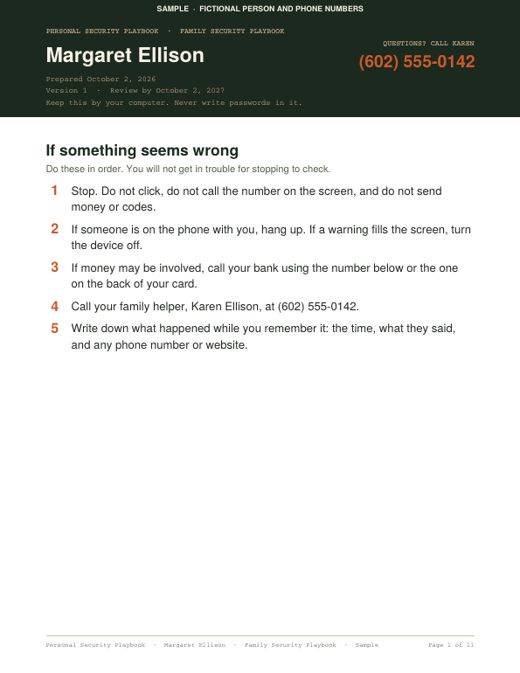
Five steps to take, in order, when something seems wrong. First: stop, and don't send money or codes.

The real phone numbers

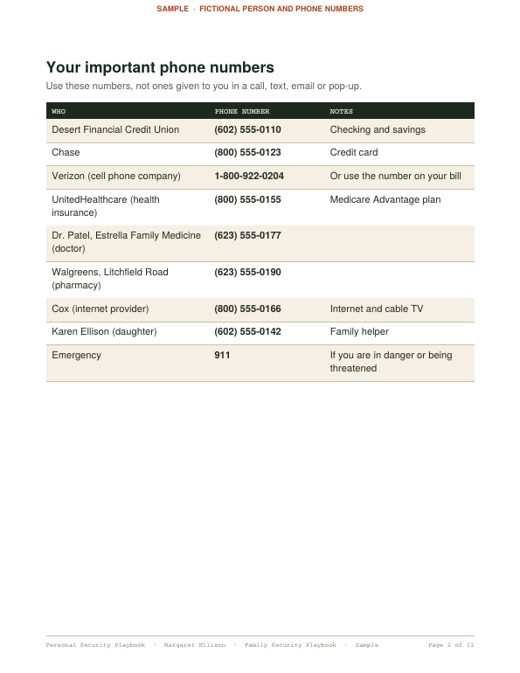
Banks, cards, the cell phone company, insurance and doctors, copied from their own cards and bills, not from a pop-up. Plus where to report fraud in your state.

How each account is protected

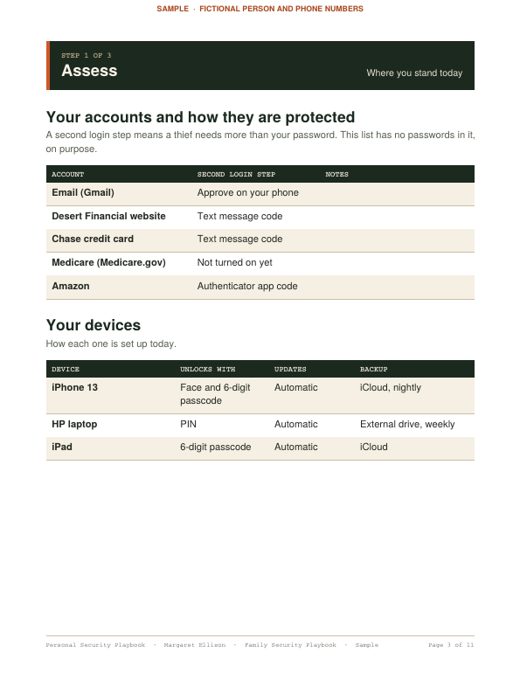
Which accounts have a second login step, and a short to-do list for the ones that don't.

A page for the family helper

What the person they call first should do, and what not to do, when the phone rings.

How to spot a scam, and what to say

The tricks that work on careful people, including cloned voices of family, plus short lines to read out before you hang up.

If your phone is lost or stolen

The steps to take within the hour, in order, with your own cell phone company's number.

A fridge page and wallet cards

The five steps and your key numbers on one page for the fridge, and two cut-out cards: one for your wallet, one for your family helper.

Monthly and yearly checks

A few minutes of checks that keep the playbook and the accounts current.

See a sample

Every name and number in the sample is made up.

Sample playbook cover and emergency page: five numbered steps under the heading If something seems wrongSample playbook page listing important phone numbers for the bank, credit card, cell phone company, insurer, doctor and pharmacySample playbook page showing how each account is protected

Open the full sample (PDF)

The three steps

  1. Buy oncePay by card. Your link appears on screen straight away, and we email it to you as well.
  2. Answer plain questionsAbout 20 minutes, ideally together. Have the bank cards, phone bill and insurance cards nearby to copy the numbers.
  3. Print and keep it by the computerDownload the PDF and print it at home, or choose the printed copy and we mail it to you.

Download the step-by-step instructions (PDF) Or read them here, with pictures of where to find each phone number on your cards and bills.

Your answers stay in your browser. The playbook is built on your own computer. We only receive it if you order a printed copy, and then delete the file within 14 days. Never type passwords, PINs or full account numbers into it.

Ready for the calls that actually come

The playbook tells your family what to do with each of these, before anyone is on the phone. Want to rehearse one first? Practice a scam call, free.

"Grandma, I'm in trouble"

Hang up and call the grandchild on their own number, or ask for the family code word.

"This is your bank's fraud department"

Hang up and call the number on the back of the card. Banks don't ask for a code they just sent you.

A warning fills the screen

Don't call the number on it. Turn the device off, then call the family helper.

The IRS, Social Security or Medicare

They don't demand payment by phone or threaten arrest. The playbook has their real numbers so you can check.

"Pay with gift cards" or crypto

No real business or agency asks for that. Stop, and call someone on the list.

"Your account is locked"

Don't use the link or number in the message. Open the account the usual way, or call the number on your bill.

Scammers don't only call grandparents

Adults over 60 report the largest losses, so they're the biggest target right now. But anyone with a phone and a bank account gets these calls, and everyone in the house can use a plan.

Older adults

"Grandma, I'm in trouble", fake bank fraud departments and tech-support pop-ups. The playbook gives them a plan on paper and a family helper to call.

Young adults and job seekers

Fake job offers, fake checks and "pay to get started". Knowing who to call, and in what order, is what limits the damage.

Busy parents

Texts about packages, tolls and "your account is locked", landing in the middle of a workday. One page says what to do, so nobody has to think it through under pressure.

Anyone who lives alone, or looks after someone

A plan you can follow by yourself, and a page for the person you'd call first.

What companies already do

Businesses keep a playbook for the day they're hacked. Your family can too.

Banks, hospitals and city governments don't wait for an attack to decide who to call. Their security teams write an incident response playbook ahead of time: the steps, the phone numbers, and who does what. It's why they can act fast instead of panicking.

The same approach, in plain words

  • Prepare: the real phone numbers and accounts, written down before anything happens
  • Respond: five steps, in order, for the moment something seems wrong
  • Recover: who to call next and how to report it
  • Review: a few minutes of checks to keep it current

Built by Jeff Cady, CISSP, an incident responder who writes these plans for organizations.

Why I built this

Jeff Cady

My son was sent a fraudulent check as part of a job onboarding scam. Knowing who to call, and in what order, is what limited the damage. This playbook puts that on paper before it's needed.

Jeff Cady, CISSP
Security consultant and incident responder, Maricopa County, Arizona. Want hands-on help instead? See personal security services.

Questions

Isn't this the same as a free checklist?

No. Free checklists give everyone the same advice, and fill-in templates leave you to work out the steps and look up every number. Your playbook is built from your answers, so it has your bank and cell phone company, your state's reporting numbers, the person you'd call first, and the accounts you actually use. It's the kind of tailored plan security teams write for companies, and that concierge services offer wealthy families, made for every household, from $39.

How is this different from a monitoring service?

Monitoring services watch your credit and accounts, and alert you after something happens, usually for a monthly fee. The playbook tells your family what to do while it's happening, on paper, with the right numbers, for one payment and with nothing to install. They work well together. The playbook also has the three credit bureaus' numbers so you can freeze your credit, which is free.

Do I need to be good with computers?

No. The questions are in plain language and one screen at a time. If a family member is helping, sit together and fill it in side by side.

What should I have nearby?

The bank and credit cards, a recent phone bill, insurance cards, and the list of accounts that matter most, such as email and banking. You copy the phone numbers from these, so the playbook has the real ones.

Do you see what I type?

Not unless you order a printed copy. The playbook is built in your browser. We only learn your email address and order from the purchase, and we keep a scrambled fingerprint of the name on the playbook so a purchase covers the right number of people. If you order a printed copy, the PDF is sent to us for printing and is deleted within 14 days.

Who can a playbook be for?

Each purchase covers one named person; the family pack covers three. You can correct and reprint the same person's playbook as often as you like while your link works.

How long does my link work?

30 days from purchase. Download the PDF before then; it's yours to keep and reprint. If you lose your link, use Open my playbook and we'll email it again.

Should I freeze my credit?

For most people, yes. A freeze stops anyone opening new credit in your name. It's free, it doesn't affect your credit score, and you can lift it for a short time when you apply for a loan or card. Do it with each of the three bureaus, Equifax, Experian and TransUnion. Their numbers are in the playbook.

How will you contact me?

By email, only from an address ending in familysecurityplaybook.com or jcady.org. We call only if you booked a review call, at the time you chose. We will never ask for a password, a code, or your card number. If someone claiming to be us does, it's a scam: hang up and email jeff@jcady.org.

Does it include my state's numbers?

Yes. Pick your state and the playbook lists your state's consumer protection office and Adult Protective Services, alongside the national fraud lines and your local police or sheriff's non-emergency number. We recheck these numbers regularly; the playbook prints the date they were last checked.

Where do printed copies ship?

Within the United States. Standard mail is free and usually arrives 7 to 14 business days after you send your playbook for printing; it has no tracking. Priority Mail with tracking is a $10 add-on at checkout, and usually arrives in 4 to 7 business days. We email you when it ships, with the tracking number if it has one.

How does the review call work?

After you buy, we email you to pick a time. Build the playbook first, then go through it with Jeff on a 30-minute phone or video call.

What are the monthly tasks?

The yearly plans include one small security task by email on the 1st of each month, about 10 minutes each: check your credit freezes, lock your phone number, get an IRS identity PIN before tax season, back up your photos, practice a scam call with the family. They keep your accounts safer and your playbook current between updates. Every email has a one-click way to stop, and we never sell or share your address.

Can we update it next year?

Yes. Phone numbers, accounts and devices change, so we suggest updating it once a year. Add the yearly renewal for $29 a year and your playbook reopens for 30 days every year, with the same link and the same people. With a new printed copy mailed each year, it's $55 a year, and for a family pack of up to three people, $69 a year. Stripe charges it automatically, and you can cancel any time. We'll also send one reminder about a year after you buy.

What if it isn't right for us?

See the refund policy, or email jeff@jcady.org.

Be ready before the phone rings

About 20 minutes today, one payment, and your family has a plan on paper.

Last reviewed October 15, 2026 by Jeff Cady, CISSP.